
When Does Tartarian Aster Bloom and How Tall Does It Grow?
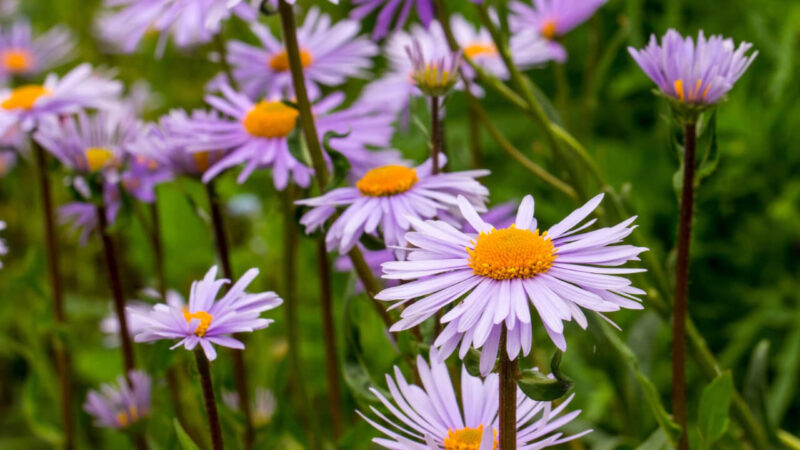
Most flowering perennials have finished their performance by the time autumn arrives. Tartarian aster is just getting started.
With towering stems, clusters of lavender-blue flowers, and an impressive ability to attract late-season pollinators, this perennial brings life to gardens that would otherwise be winding down for winter.
But its size deserves serious consideration. Tartarian aster is not a delicate little flower you can squeeze between other plants. It grows tall, spreads enthusiastically, and demands enough space to develop properly.
Tartarian aster typically blooms from September through October and reaches 3 to 6 feet (90–180 cm) tall. In favorable conditions, some plants grow even taller, while compact cultivars remain considerably shorter.
Here’s what gardeners should know before giving this autumn giant a permanent home.
What Is Tartarian Aster?
Tartarian aster, more commonly spelled Tatarian aster, is a perennial flowering plant native to eastern Asia. Its botanical name is Aster tataricus, although some botanical references classify it under Crinitaria tatarica or Galatella tataricus.
Unlike many smaller garden asters, this species produces substantial upright stems topped with branching clusters of daisy-like flowers.
Its most recognizable features include:
- Flowers: Lavender-blue to violet petals surrounding yellow centers.
- Leaves: Large, paddle-shaped leaves near the base, becoming progressively smaller higher up.
- Growth habit: Tall, upright stems emerging from spreading underground rhizomes.
- Lifespan: A hardy herbaceous perennial that returns each spring.
- Wildlife value: A source of late-season nectar for bees, butterflies, and other pollinating insects.
It belongs to the Asteraceae family, alongside sunflowers, daisies, and chrysanthemums.
When Does Tartarian Aster Bloom?
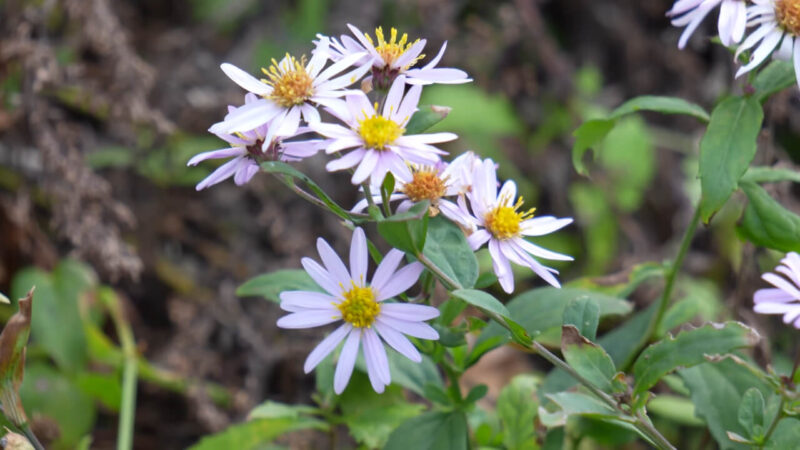
The main flowering season for Tartarian aster is September through October in most temperate Northern Hemisphere gardens.
It is one of the later-blooming asters, often producing flowers when summer perennials have already faded.
The exact flowering schedule depends on climate, local temperatures, and growing conditions.
| Season | What to Expect |
| Spring | Fresh leaves and new shoots emerge. |
| Early summer | Rapid stem and foliage growth. |
| Late summer | Flower buds begin developing. |
| September | Main flowering season begins in many regions. |
| October | Flowering continues, often until frost. |
| November | Blooms may persist in mild climates. |
In colder regions, an early hard frost can shorten the flowering period. Gardens with longer, milder autumns may enjoy blossoms well into November.
According to the Missouri Botanical Garden, the species is particularly notable for its late autumn flowers, which can remain attractive around the arrival of the first frost.
Why Does It Flower So Late?
Tartarian aster spends much of the growing season building its substantial foliage and upright stems.
Rather than flowering alongside spring and early-summer perennials, it produces its main floral display in autumn.
That timing is its greatest ornamental advantage.
A garden that relies entirely on spring and summer flowers is an unfinished garden. Late-flowering plants like Tartarian aster provide color and ecological value when both are becoming scarce.
How Tall Does Tartarian Aster Grow?
View this post on Instagram
Mature Tartarian aster plants generally reach 3–6 feet (90–180 cm), with many established specimens growing approximately 4–6 feet tall.
The species can approach 7 feet (2.1 m) in particularly favorable conditions.
Individual clumps commonly occupy around 2–3 feet (60–90 cm) across, although underground rhizomes can gradually extend the planting well beyond that original footprint.
These dimensions make it unsuitable for the front of a conventional flower border.
Instead, use it where its height becomes an advantage:
- Along the back of wide perennial beds.
- Behind shorter autumn-flowering plants.
- In spacious naturalistic or meadow-style plantings.
- As a seasonal screen where summer growth can develop freely.
In overly rich, moist soil, stems may become especially tall and occasionally require support. Under ordinary growing conditions, however, they are generally sturdy.
Is There a Shorter Tartarian Aster Variety?
Yes. Gardeners who appreciate the flowers but dislike the height should consider Tartarian aster ‘Jindai’.
This compact cultivar typically reaches approximately 3–4 feet (90–120 cm), making it considerably easier to incorporate into smaller gardens.
It retains the characteristic lavender-purple flowers and autumn flowering habit of the larger species.
The Royal Horticultural Society’s plant profile describes ‘Jindai’ as a compact, autumn-flowering cultivar suited to sunny positions and well-drained soil.
For most modest residential borders, ‘Jindai’ is the more sensible purchase.
There is little point planting a six-foot perennial and spending every summer fighting its natural height when a shorter selection is available.
How to Grow Tartarian Aster Successfully
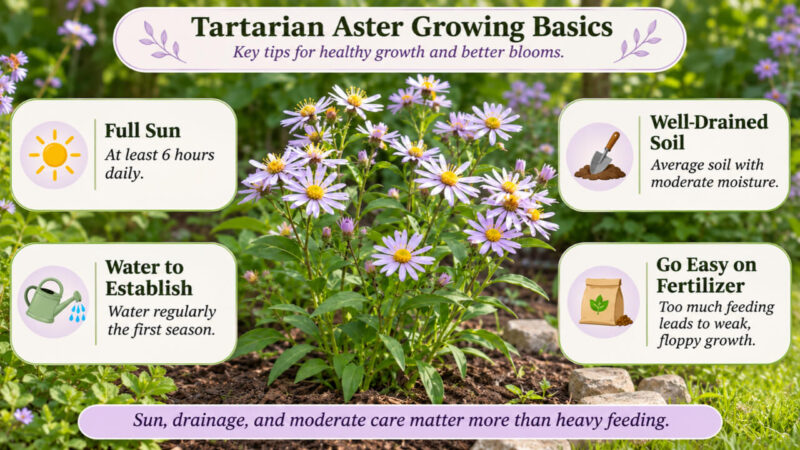
Tartarian aster is remarkably adaptable, but that does not mean planting conditions are irrelevant.
A few straightforward decisions will improve both flowering and overall appearance.
1. Give It Plenty of Sunlight
Full sun is the best choice for strong stems and abundant flowers.
Aim for at least six hours of direct sunlight daily.
Some partial shade may be tolerated, but heavily shaded positions are a poor choice if flowering is your priority.
2. Choose Well-Drained Soil
Average garden soil with moderate moisture is generally sufficient.
Avoid prolonged waterlogging, and resist the temptation to turn the planting hole into an excessively rich pocket of compost and fertilizer.
Tartarian aster does not need luxurious growing conditions to perform well.
3. Water During Establishment
Water newly planted asters regularly during their first growing season, particularly through dry spells.
Once established, plants are more resilient, although extended drought can still affect foliage and flowering.
4. Avoid Excessive Fertilizer
Heavy feeding is usually unnecessary.
Excessively fertile conditions can encourage taller, softer growth that is more likely to lean or require staking.
More fertilizer does not automatically mean more flowers. For this plant, good sunlight and appropriate soil conditions matter far more.
Does Tartarian Aster Spread Aggressively?
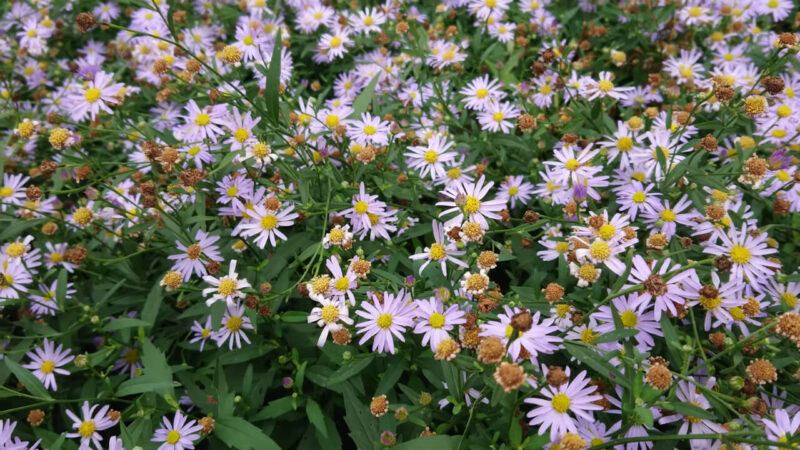
Yes, and this is the plant’s biggest drawback.
Tartarian aster spreads through underground rhizomes, allowing established clumps to expand beyond their original planting area.
In favorable conditions, it can become an assertive competitor, particularly alongside smaller, slower-growing perennials.
The North Carolina Extension Gardener Plant Toolbox specifically warns about its vigorous rhizomatous growth.
To keep it manageable:
- Inspect the planting each spring for shoots emerging beyond the intended area.
- Remove unwanted shoots and their attached rhizomes rather than simply cutting off the leaves.
- Divide established clumps approximately every three to four years when necessary.
- Avoid planting it immediately beside delicate or easily overwhelmed perennials.
Its spreading habit should not be confused with a universal invasive designation. Invasive status varies by location and should be checked against regional guidance.
Nevertheless, this is not a plant to introduce casually into a tightly managed border.
Can You Keep Tartarian Aster Shorter?
Cutting stems back by approximately one-third in late spring or early summer can encourage bushier, shorter growth.
However, pruning may also delay flowering.
That matters with a plant whose natural blooming season is already close to the first autumn frosts.
Avoid making substantial cuts once flower buds are developing.
For gardeners living in regions with short growing seasons, repeatedly delaying autumn flowering is a poor trade-off.
Our preference is rather simple – choose the correct mature plant height before planting rather than relying on annual corrective pruning.
Is Tartarian Aster Good for Pollinators?
Absolutely. Its late flowering period makes Tartarian aster useful to bees, butterflies, and other insects seeking nectar in autumn.
Large, established plants can produce numerous flowerheads, creating a concentrated late-season feeding opportunity.
This is particularly valuable when many summer flowers have stopped producing nectar.
However, Tartarian aster originates in Asia. Gardeners in North America who prioritize native biodiversity should also consider locally native autumn asters.
Plants such as New England aster (Symphyotrichum novae-angliae) may provide additional ecological relationships with native insects.
The strongest pollinator gardens are not built around one impressive flowering species. They provide a succession of suitable plants throughout the growing season.
For more information about unusual species and their growing habits, explore the GardenFizz plant profiles.
FAQs
Does Tartarian Aster Come Back Every Year?
Yes. It is a hardy herbaceous perennial. Its aboveground stems die back during winter, while the underground root system survives and produces new shoots in spring.
Can Tartarian Aster Grow in Containers?
It is possible, especially with compact cultivars, but large species plants are poorly suited to ordinary patio pots. Their height, spreading roots, and moisture requirements make in-ground planting the better option.
Does Tartarian Aster Need Staking?
Not usually. Its naturally sturdy stems often support themselves, although plants growing in particularly fertile, moist soil or exposed, windy locations may benefit from support.
Should You Deadhead Tartarian Aster?
Deadheading can improve appearance and remove fading flowers, but it is not essential for a successful autumn display. After flowering, stems can be cut back or left standing through winter before spring cleanup.
So, Is Tartarian Aster Worth Growing?
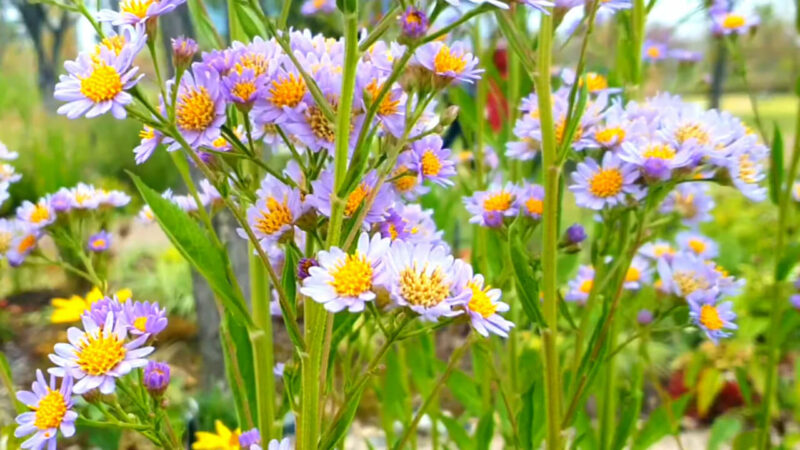
Tartarian aster deserves its reputation as an outstanding late-season perennial.
Its September and October flowers provide welcome color, its tall stems add structure, and its nectar-rich blooms support pollinators when many other plants are finished flowering.
But its vigor comes with a responsibility.
If you have room for a bold, spreading autumn perennial, Tartarian aster is an excellent choice. If you need a restrained, compact border plant, choose ‘Jindai’ or another smaller aster instead.
The best gardens are not the ones packed with the greatest number of plants. They’re the ones where every plant has the space and conditions to do what it does best.