
The Orchid That Looks and Smells Like a Bee
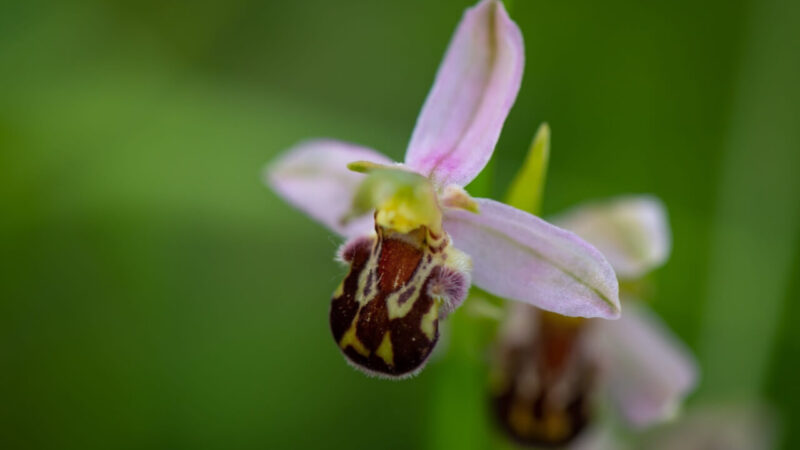
Imagine walking through a meadow and noticing a tiny bee sitting perfectly still on a pink flower. You lean closer, expecting it to fly away, only to discover that the bee is actually part of the flower itself.
Meet the bee orchid, a fascinating wildflower that has developed an extraordinary resemblance to a female bee. Several related orchids take the deception further, producing chemical signals that imitate the scents female insects use to attract mates.
Male insects can mistake these flowers for potential partners, accidentally collecting pollen during their unsuccessful mating attempts.
Strangely enough, the common bee orchid (Ophrys apifera) often manages perfectly well without any insect assistance.
So, how does a flower develop such a convincing disguise, and why does it sometimes have no need for the bees it imitates?
Meet the Bee Orchid – A Flower Disguised as an Insect
Bee orchids belong to the genus Ophrys, a group of terrestrial orchids known for flowers that resemble insects.
One of the most recognizable species is Ophrys apifera, a member of the orchid family, Orchidaceae.
At first glance, its flowers look like small insects resting among delicate pink petals. A closer inspection reveals several distinctive features:
| Feature | Description |
| Pink or purple sepals | Three petal-like structures surround the flower. |
| Fuzzy brown lip | A velvety structure resembling a female bee’s body. |
| Yellow markings | Irregular patterns create an insect-like appearance. |
| Small green leaves | A basal rosette with additional leaves along the stem. |
A single bee orchid can produce up to 11 flowers along its stem, with individual blooms reaching 1 inch (2.5 centimeters) across.
Despite their small size, these flowers have an unusually detailed structure, making their resemblance to insects particularly interesting when viewed up close.
Individual plants can reach approximately 12 inches (30 centimeters) tall, although many are considerably smaller.
In Britain, bee orchids typically flower between June and July. They favor open grasslands, meadows, coastal habitats, and areas containing chalky or limestone soils.
Interestingly, they occasionally appear along roadsides, on disturbed ground, and in lawns where mowing has been reduced.
Several other Ophrys species share similar characteristics, although their floral shapes, chemical signals, and pollinating insects vary.
Some resemble bees, while others imitate particular species of wasps or other insects.
How Does an Orchid Look and Smell Like a Bee?
Flowering plants generally attract pollinators by offering nectar, pollen, or other resources. Certain bee orchids have developed a considerably more deceptive approach.
Their flowers imitate characteristics associated with female insects, encouraging males to approach and investigate.
Deceptive pollination is surprisingly widespread among orchids. A major scientific review found that 46% of studied orchid species with documented attraction methods used some form of deception.
A Convincing Disguise
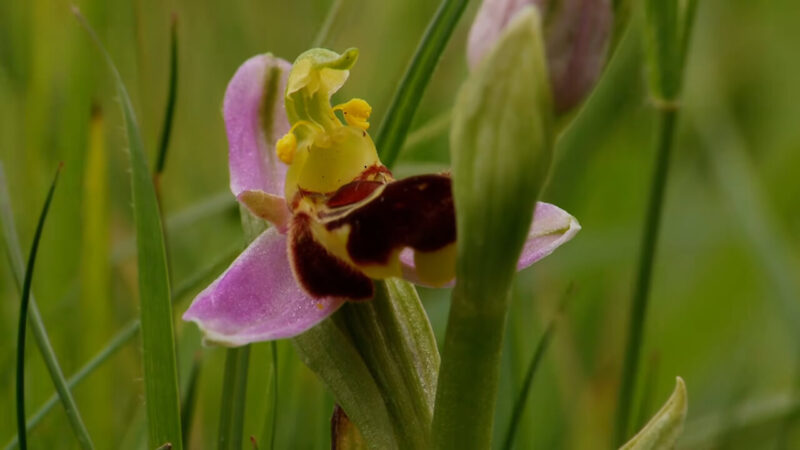
Look closely at a bee orchid’s central lip, and its resemblance to an insect becomes easier to recognize.
Fine hairs give it a velvety texture, while its rounded shape resembles an insect’s abdomen. Brown coloration and yellow markings add further detail, producing a surprisingly realistic impression.
Even the surrounding pink sepals help frame the imitation.
However, insects do not necessarily interpret floral appearances in the same way humans do. Their visual systems respond to different combinations of color, contrast, shape, and other signals.
For some sexually deceptive orchids, visual characteristics help approaching insects recognize or position themselves on the flower.
Such elaborate structures developed gradually through natural selection. Floral traits that encouraged successful pollination could become more common over successive generations.
Plants with characteristics that attracted suitable insects had opportunities to produce offspring, passing along the traits responsible for their reproductive success.
The Chemical Trick Behind Its Scent
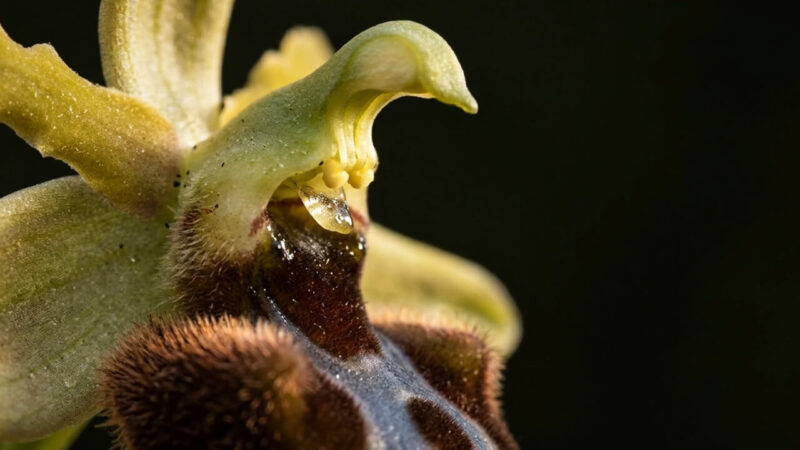
Appearance is only part of the deception.
Certain Ophrys orchids produce chemical compounds that resemble the sex pheromones released by female insects.
Pheromones are chemical signals that insects use to communicate, including when searching for mating partners.
Male bees can detect these compounds using sensitive receptors on their antennae. When an orchid produces a sufficiently convincing chemical signal, a male may approach the flower expecting to encounter a receptive female.
Some orchids imitate particular combinations of hydrocarbons associated with their pollinators’ mating signals.
Chemical composition matters because closely related insects can respond to different combinations and proportions of these substances.
Consequently, individual orchid species may attract a relatively narrow group of pollinating insects.
Floral scent can be so specific that even closely related orchids attract different insects. One scientific comparison found that 98% of studied Ophrys species pairs attracted different pollinators, largely because of differences in their chemical signals.
For these orchids, a slight change in scent may influence which insects visit their flowers.
One detail deserves clarification: an orchid that smells like a female bee to another bee does not necessarily produce an obvious bee-like scent to humans.
Our noses and insect antennae respond differently to chemical signals, and many compounds involved in insect communication are difficult for people to detect.
How Bee Orchids Trick Bees Into Pollinating Them
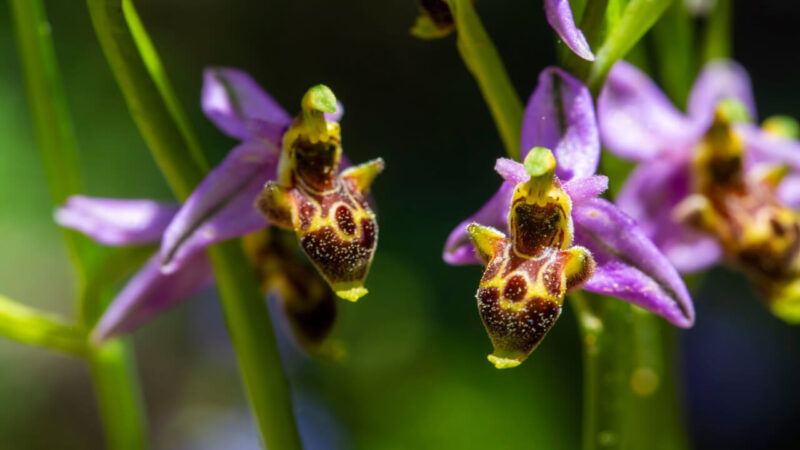
Sexually deceptive orchids rely on an unusual interaction called pseudocopulation.
During pseudocopulation, a male insect attempts to mate with a flower after mistaking its visual or chemical signals for those of a female.
Although the insect’s efforts are unsuccessful, its movements can help the orchid reproduce.
A typical interaction follows several steps:
- Attraction – A male insect detects chemical signals associated with a potential mate and approaches the orchid.
- Landing – It settles on the flower’s lip, responding to the floral signals and physical structure.
- Mating attempt – Its movements bring its body into contact with the orchid’s reproductive structures.
- Pollen attachment – Sticky pollen packets, known as pollinia, attach to a suitable part of the insect’s body.
- Pollen transfer – If the insect visits another compatible flower, the pollinia may contact its receptive stigma, allowing pollination.
Unlike flowers that reward pollinators with nectar, sexually deceptive orchids generally offer no nutritional benefit during these visits.
A male insect can spend valuable time and energy attempting to mate with a flower and receive absolutely nothing in return.
For the orchid, however, even a brief visit may provide an opportunity to transfer pollen.
Successful pollination depends on several factors, including the insect’s behavior, the placement of the pollinia, and contact with the reproductive structures of another flower.
Such specialized interactions help explain why some orchids depend heavily on particular insect species.
Changes in pollinator availability can therefore have important consequences for their reproduction.
Can You Grow Bee Orchids in Your Garden?
View this post on Instagram
Finding a bee orchid growing naturally in a garden would be a wonderful discovery. Deliberately cultivating one, however, is considerably more difficult than growing familiar ornamental orchids.
Wild bee orchids have specialized relationships with their surroundings, particularly with fungi living in the soil.
Orchid seeds are exceptionally small and contain very limited food reserves. During natural germination, they typically depend on compatible mycorrhizal fungi to supply nutrients needed for early development.
Without appropriate fungal partners and suitable environmental conditions, successful establishment can be difficult.
For Ophrys apifera, favorable habitats frequently include relatively open areas with well-drained, calcium-containing soils and limited competition.
Heavy fertilization, dense vegetation, and frequent disturbance can make conditions less suitable.
If bee orchids appear naturally on your property, we recommend a few simple precautions:
| Tip | Recommendation |
| Avoid mowing | Let flowers bloom and produce seeds. |
| Limit soil disturbance | Protect roots and beneficial fungi. |
| Avoid fertilizer | Prevent excessive grass growth. |
| Maintain drainage | Keep soil well-drained. |
| Leave wild plants | Avoid digging up or transplanting orchids. |
A carefully managed wildflower area can provide suitable conditions for naturally occurring orchids, particularly where the local soil and climate already favor them.
However, creating an appropriate habitat does not guarantee their arrival.
We recommend supporting existing plants rather than attempting to relocate specimens collected in the wild.
Summary
Bee orchids demonstrate just how intricate relationships between flowering plants and insects can become.
Their insect-like appearance and carefully matched chemical signals can encourage male insects to participate in pollination without realizing it.
Yet Ophrys apifera adds another layer of intrigue by frequently reproducing without insect assistance.
For us, that makes encountering one in a meadow particularly interesting. A flower that appears to be carrying a tiny bee has a surprisingly complicated reproductive story, and one worth protecting.